


Open Access
About Acta Acustica
History
Acta Acustica originated in the early 1990s as an initiative of the European Acoustics Association (EAA) to provide a unified platform for acoustics research in Europe. It was first published by Hirzel Verlag and later became Acta Acustica united with Acustica in 1996, following the merger of national and European acoustics journals. In 2020, the journal was relaunched by EDP Sciences as Acta Acustica and adopted a Gold Open Access model, supported by the EAA and national acoustical societies.
In 2025, the journal transitioned to Diamond Open Access, thanks to the financial support of the French National Center for Scientific Research (CNRS), Technische Informationsbibliothek (TIB), the French Acoustical Society (SFAv), and the European Acoustics Association (EAA). More information here.
The journal today
Aims & Scope
Acta Acustica publishes original research articles, review papers, technical and applied contributions, short communications, and letters to the editor covering all areas of acoustics. Both theoretical and applied studies are welcome.
The journal embraces a broad scope within acoustics, including but not limited to: linear and nonlinear acoustics, aeroacoustics, acoustic signal processing, electroacoustics, environmental and building acoustics, musical acoustics, psychoacoustics, physiological and psychological acoustics, speech, ultrasonic and underwater acoustics, and vibroacoustics.
Priority is given to work that advances scientific knowledge in acoustics and its engineering applications, fosters interdisciplinary collaboration, or supports the development of new methodologies and technologies relevant to sound and vibration. Special attention is given to submissions that contribute to open, inclusive, and high-quality scientific communication within the acoustics community.
More information here.
Publication & business model
All articles in Acta Acustica are published under a Creative Commons CC-BY license, and copyright remains with the authors. The journal is owned by the European Acoustics Association (EAA) and published by EDP Sciences.
The scientific content of the journal is entirely under the responsibility of the Editor-in-Chief and the international editorial board, composed of associate editors and experts covering all areas of acoustics.
A steering committee meets regularly, with representatives from the EAA, EDP Sciences, and the editorial leadership, to review the journal's editorial and financial progress, assess its strategy, and plan future developments.
EDP Sciences provides the technical infrastructure (peer-review and publication platforms), production workflow management, copy-editing, typesetting, and dissemination services. However, it does not intervene neither in the peer-review process nor in the scientific editorial decisions, which are managed independently by the journal’s editorial team.
Since changing publisher in 2020, Acta Acustica has been fully Open Access and has changed its title to reflect the evolution of its Aims & Scope. Please read about the latest achievements of the journal here.
Sponsorship of Acta Acustica in an Open Access Diamond Model
The Diamond Open Access model is increasingly recognised as a fair and equitable approach to scholarly publishing. It enables authors to publish without paying article processing charges, while ensuring that research is freely accessible to readers worldwide.
Diamond Open Access
Diamond Open Access:
- Enhances the visibility, accessibility, and impact of scientific research by removing financial barriers for both authors and readers
- Supports research quality, integrity, and innovation by aligning with the principles of open science and FAIR data
However, the model also presents challenges. Its long-term sustainability depends on coordinated support from a broad range of stakeholders, including researchers, editors, universities, funders, libraries, publishers, and policymakers. Continued collaboration is essential to ensure that Diamond Open Access can develop and thrive as a viable publishing route.
Funding support for Acta Acustica
Since 1 January 2025, the journal has been funded through the generous support of the following organisations:
- The European Acoustics Association (EAA)
- Technische Informationsbibliothek (TIB), on behalf of academic and research institutions in Germany, Austria and Switzerland)
- French National Center for Scientific Research (CNRS)
- The French Acoustical Society (SFA)
Their contributions have made it possible to operate the journal under a Diamond Open Access model, with no charges for authors or readers in 2025.
However, to maintain and develop this model over the long term, continued and expanded financial support will be essential.
While this funding guarantees full Diamond OA publication for the first year, additional support is urgently needed to sustain this equitable model and expand its global reach. Current funding supports the publication of approximately 90 articles per year. As a long-standing advocate for open access, EDP Sciences is committed to ensuring that high-quality articles exceeding this number can continue to be published.
The journal’s scientific quality, its Diamond Open Access model, and the editorial leadership of the scientific community are expected to drive further growth. To support this development and safeguard the sustainability of the Diamond model, we are now seeking additional institutional sponsors.
As of 1 October 2025, the updated financial projections set out the budget required to meet our publication goals and to sustain the Diamond Open Access model in the coming years. In line with the focus of the funding campaign (2026–2027), the 2025 target is now considered fully met, and the remaining funding needs for 2026 have been adjusted accordingly.
| Year | Volume of Articles Published | Budget Needed | Missing Funding |
| 2025 | 90 | €90,000 | Achieved |
| 2026 | 100 | €100,000 | €4,000 |
| 2027 | 110 | €110,000 | €21,500 |
For 2026, we plan to publish 100 articles and are still seeking €6,000 to reach this target. For 2027, with a planned 110 articles to be published, we still require €21,500.
A contribution of €1,000, the former APC and a fair estimate of what is required to publish one article, is the minimum needed to support Diamond Open Access publication. As additional guidance, we encourage institutions to consider an annual contribution of €2,000, the equivalent of supporting two articles. Further details on the breakdown of editorial and publishing costs can be found here.
This level of support helps to:
- Support the continued growth of the journal
- Strengthen its international scientific standing
- Distribute publication costs more equitably among supporters
- Provide financial resilience in the event that a sponsor withdraws
Sponsors will be acknowledged on the journal’s home page and invited to join the journal’s steering committee. In addition, institutions may nominate researchers in the field to serve on the editorial board. Most importantly, your support will help ensure that researchers from around the world can continue to publish in Acta Acustica without financial barriers.
Learn more about Acta Acustica Open Access Sponsors & Ambassadors.
About the European Acoustics Association (EAA)
The European Acoustics Association (EAA) is a non-profit organization that brings together national acoustical societies across Europe. Founded in 1992, it serves as a platform for scientific collaboration, knowledge exchange, and the promotion of acoustics in all its dimensions — scientific, technical, and educational. Its mission includes supporting young researchers, encouraging excellence in acoustic research and education, and fostering cooperation among acousticians across Europe and beyond. The Association organises major international conferences such as Forum Acusticum, and is also actively involved in thematic schools, awards, and educational outreach initiatives.
Acta Acustica, the official journal of the EAA, is a cornerstone of the Association’s mission to disseminate high-quality research and support open and inclusive scientific communication.
More information: https://euracoustics.org
About EDP Sciences
EDP Sciences was established in 1920 by a prestigious academic community of French learned societies seeking to inspire, innovate and inform others by sharing their knowledge. Today, EDP Sciences continues to be dedicated to advancing scientific communication. With a strong commitment to transparency and innovation, EDP Sciences partners with organisations to develop sustainable open access publishing models.
A short introduction to EDP Sciences is available here: https://www.youtube.com/watch?v=5s_e8SUj3qU
For further information, please contact:
Editor-in-Chief: Manfred Kaltenbacher This email address is being protected from spambots. You need JavaScript enabled to view it. ; This email address is being protected from spambots. You need JavaScript enabled to view it. . EDP Sciences Publishing Editors: Karolina Wojtczak This email address is being protected from spambots. You need JavaScript enabled to view it. ; Selina La Barbera This email address is being protected from spambots. You need JavaScript enabled to view it. EDP Sciences Subscription Sales Manager This email address is being protected from spambots. You need JavaScript enabled to view it.
Our Progress So Far
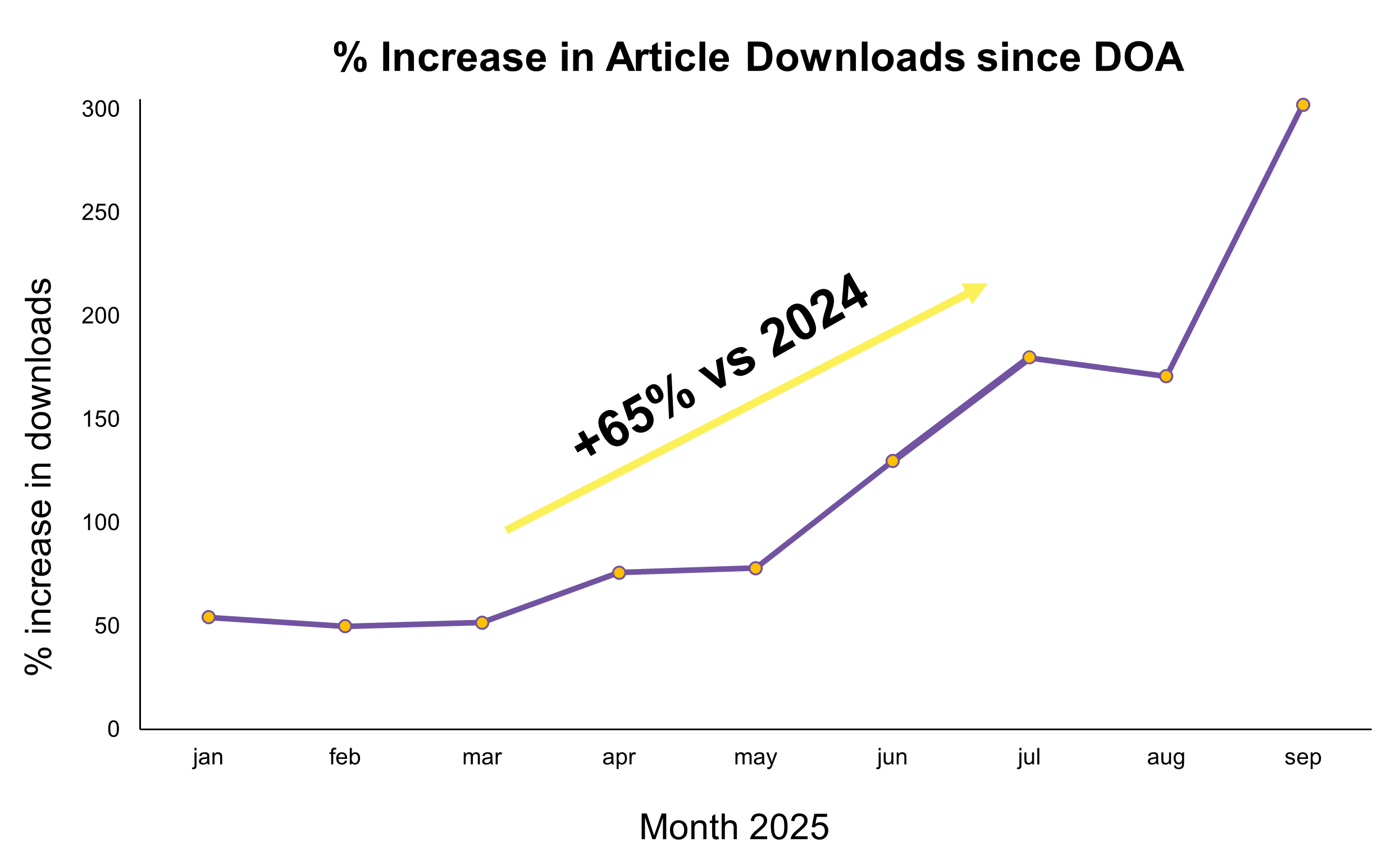
A significant increase in article downloads, reflecting broader global reach and visibility: a +65% increase compared to 2024, already matching the growth seen from 2023-24. With monthly increases of an average +120% per month compared to the 2024 average.
Greater diversity in submission origins, with more authors from underrepresented regions contributing to the journal: In 9 months in DOA Acta Acustica has attracted submissions from 41 countries, including 6 countries from the Research4Life program. This represents almost double the diversity compared to the previous three years.

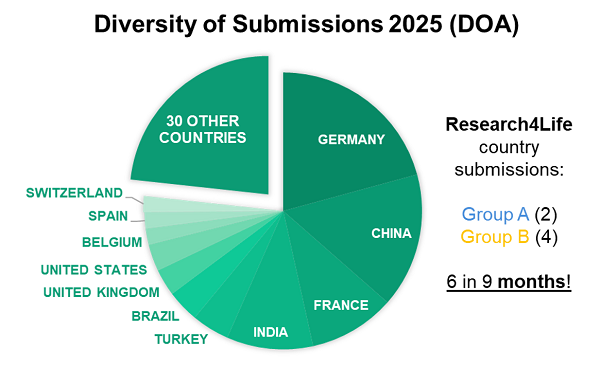
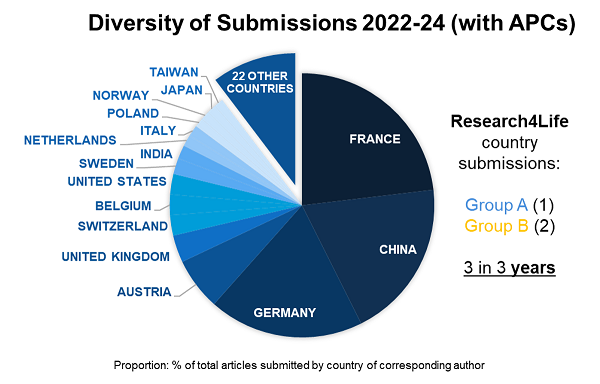
These outcomes confirm that removing financial barriers for authors and readers fosters a more inclusive and impactful scientific dialogue.
Following our July 2025 call for contributions, several institutions have already joined this collective effort. We gratefully acknowledge the early supporters responding to the campaign:
Their participation strengthens the long-term sustainability of the Diamond Open Access model and contributes directly to keeping Acta Acustica freely accessible to the global acoustics community. This data is summarised in this Diamond Open Access leaflet.
Why support the Diamond Open Access model for Acta Acustica?
Supporting Acta Acustica through the Diamond Open Access model offers clear benefits for both institutions and the wider scientific community:
- Secures the continuity and long-term sustainability of a high-quality, community-owned journal in acoustics
- Enables unlimited Open Access publishing for authors, removing financial and administrative barriers to publication
- Demonstrates meaningful support for the global shift toward equitable, Diamond Open Access publishing
By participating in this model, institutions and individual researchers not only help sustain Acta Acustica, but also contribute to a more inclusive and accessible scholarly communication system aligned with international open science goals.
Our Sponsors
The contributions of our sponsors have made it possible to operate the journal under a Diamond Open Access model, with no charges for authors or readers in 2025.
Since 1 January 2025, the journal has been funded through the generous support of the following organisations:
EAA
The European Acoustics Association (EAA) founded in 1992, is a non-profit organization representing 33 national societies and over 9,000 members across Europe. Dedicated to advancing acoustics in all its facets, the EAA promotes collaboration, research, education, and open-access initiatives to benefit the global community.

TIB
The German National Library of Science and Technology (TIB) is a leading institution dedicated to providing comprehensive access to scientific and technical information. As the world’s largest specialised library in its subject areas, TIB offers a vast collection of resources, including literature, patents, and audiovisual materials, serving the needs of researchers, industry professionals, and the public. Committed to advancing open science, TIB actively engages in research and development projects, focusing on areas such as digital preservation, data management, and the promotion of open access initiatives.

TIB institutions included in Consortium
- RWTH Aachen, Universitaetsbibliothek
- Staatliches Institut fuer Musikforschung
- Technischen Universitaet Berlin, Universitaetsbibliothek
- Physikalisch-Technische Bundesanstalt Braunschweig, Bibliothek
- Technische Universitaet Dresden, Saechsische Landesbibliothek – Staats- und Universitaetsbibliothek Dresden (SLUB)
- Goethe Universitaet Frankfurt, Universitaetsbibliothek Johann Christian Senckenberg
- Technische Universitaet Graz
- Technische Informationsbibliothek (TIB)*
- Leibniz Universitaet Hannover (LUH), Technische Informationsbibliothek (TIB)
- Universitaet Oldenburg, BIS – Bibliotheks- und Informationssystem
- Deutsches Zentrum fuer Luft- und Raumfahrt (DLR)
- Universitaet Stuttgart, Universitaetsbibliothek
- Oesterreichische Akademie der Wissenschaften / Institut fuer Schallforschung
- Technische Universitaet Wien
- mdw – Universitaet fuer Musik und darstellende Kunst Wien
- Jade Hochschule Wilhelmshaven/Oldenburg/Elsfleth
- ETH Zürich, Bibliothek
CNRS
The French National Centre for Scientific Research (CNRS) is a world leader in scientific research, fostering innovation across disciplines. CNRS champions open access to promote knowledge sharing and equitable access to scientific advances.

SFA
The aim of the French Acoustics Society is to promote the circulation of scientific and technical information between the various players in the acoustics field, as well as contacts between research laboratories and industry. It currently has 860 individual members (researchers, teachers, engineers, musicians, audiologists, architects, etc.), as well as 25 institutional members (industrial companies and laboratories specializing in acoustics).

Our Ambassadors
Since 1 July 2025, a call for contributions has been open to support Open Access publication in Acta Acustica (see Diamond Open Access leaflet (PDF)).
We acknowledge individual researchers and institutions who take part in this initiative and actively support the Diamond Open Access model. These ambassadors are recognized for having:
- Reached out to their university or institute's research director to inform and engage them in the initiative;
- Contacted their institutional librarian to advocate for continued support;
- Raised awareness of the need for sustainable funding to keep Acta Acustica content openly accessible to both authors and readers.
Below we warmly thank the institutions that have already responded to this call. Their commitment helps sustain the Diamond Open Access model of Acta Acustica, ensuring that high-quality acoustics research remains freely accessible to the global community.
Lib4RI
Lib4RI is the joint scientific library serving the four Swiss federal research institutes: WSL, Empa, Eawag and PSI. Its mission is to provide researchers with high-quality information resources, promote open science practices, and support knowledge dissemination across environmental, materials, water and energy sciences.

École Centrale de Lyon
École Centrale de Lyon is one of France’s leading Grandes Écoles, known for excellence in engineering education and research. With strong scientific programs in acoustics, mechanics and physics, the institution fosters innovation and collaboration across academia and industry and actively promotes open dissemination of scientific knowledge.

About EPFL
The École Polytechnique Fédérale de Lausanne (EPFL) is a world-class research institution and one of Europe’s most dynamic science and technology campuses. EPFL is committed to advancing fundamental and applied research, strengthening interdisciplinary innovation, and supporting open access to scientific results as part of its global mission.

Imperial College London
Imperial College London is a leading research and teaching institution specialised in science, technology, engineering, medicine and business. They are committed to support open research and advance the discovery and sharing of knowledge by supporting open access initiatives.
