


Figure 1
Download original image
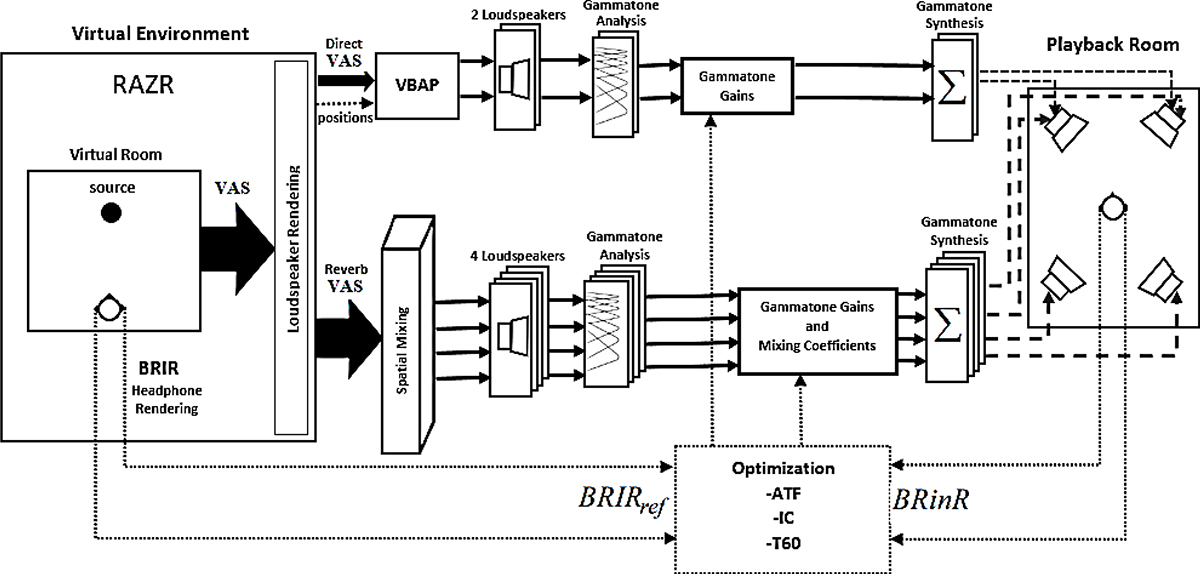
A block diagram of the ART approach. The RAZR room simulator provides two outputs: binaural room impulse responses (BRIRs) at the listener position for headphone rendering, and virtual acoustic sources (VASs) for the direct and reverberant components for loudspeaker rendering. In the upper signal flow, the VASs of the direct sound are mapped onto two loudspeakers using the Vector Base Amplitude Panning (VBAP) method, and the signals are rendered in the playback room after filtering. In the lower signal flow, the VASs of the reverberant sound are mapped onto four loudspeakers using spatial mixing. These signals are then mixed and filtered to control both the interaural coherence (IC) and the reverberant energy at the listening position in the playback room. To preserve the energy characteristics of the original signals, both the direct and reverberant components are compensated using Gammatone filterbank analysis and synthesis prior to playback. In the optimization block, the simulated BRIRs (BRIRref) are compared with the reproduced binaural room-in-room impulse responses (BRinR) measured in the playback room. This comparison is used to determine the optimal mixing coefficients for the reverberant signals, as well as the optimal Gammatone filter gains for both direct and reverberant components. Additionally, the reproduced reverberation time (T60) is controlled by adjusting the separation time between the direct and reverberant parts in both BRIRref and BRinR.
Current usage metrics show cumulative count of Article Views (full-text article views including HTML views, PDF and ePub downloads, according to the available data) and Abstracts Views on Vision4Press platform.
Data correspond to usage on the plateform after 2015. The current usage metrics is available 48-96 hours after online publication and is updated daily on week days.
Initial download of the metrics may take a while.